

Choosing between cream, powder, and liquid blush comes down to your skin’s surface lipid balance, texture level, and desired longevity:
- Powder Blush (Talc/Mica + Binders): Best for oily and acne-prone skin. Absorbs excess sebum, blurs pore texture, offers buildable medium-to-full coverage, and lasts 8–12 hours.
- Cream Blush (Wax/Butter + Emollients): Best for dry, normal, and mature skin. Provides a dewy, skin-like finish, melts seamlessly over fine lines without settling, and delivers 4–6 hours of hydration-rich wear.
- Liquid Blush (Water/Silicone Suspension + High Pigment Load): Best for combination, normal, and long-wear requirements. Delivers lightweight, second-skin stain pigmentation that sets fast and withstands sweat and humidity for 10+ hours.
The Golden Rule: Match the blush carrier base (powder, oil-in-wax, or silicone/water polymer) to your base foundation and natural sebum production to prevent separation, pilling, or premature fading.
1. The Science Behind Blush Formulations
A blush is not just color; it is a complex vehicle system engineered to deliver pigment particles onto human epidermis. Understanding the formulation vehicle explains why products behave radically differently across skin types:
- Powder Systems: Composed of absorbent fillers (talc, synthetic fluorphlogopite, silica, cornstarch), optical diffusers (mica, boron nitride), and binders (zinc stearate, dimethicone). They sit atop the skin’s lipid barrier, relying on mechanical adherence and surface tension absorption.
- Cream Systems (Anhydrous/Lipid Systems): Built on fatty acids, ester oils, carnauba/candelilla wax, and plant butters (shea butter, caprylic/capric triglyceride). Pigments are dispersed in an oil-wax matrix. When skin temperature warms the waxes, the product blends into the stratum corneum with high refractive index (dewy glow).
- Liquid Systems (Emulsions & Volatile Suspensions): Water-in-silicone (W/Si) or water-in-oil (W/O) emulsions utilizing volatile silicones (cyclopentasiloxane, isododecane) and film formers (trimethylsiloxysilicate). As the volatile carrier evaporates upon application, micro-pigments and film polymers lock tightly onto the skin surface.
2. Why Formula Selection Dictates Makeup Longevity and Skin Health
Mismatched blush formulas cause three major cosmetic failures:
- Texture Magnification: Applying heavy powder over dehydrated skin pulls ambient moisture from the epidermis, accentuating flaking and micro-wrinkles.
- Emulsion Breaking (Separation): Applying an oil-rich cream blush over an unset silicone or water-based liquid foundation causes phase inversion, leading to curdling, patchiness, and lifting of base makeup.
- Oxidation & Color Degradation: Excessive skin sebum can interact with un-coated mineral pigments (iron oxides, red lakes), darkening the color by 1–2 shades within hours.
Selecting the right blush formula is not simply a stylistic preference—it is a functional interface between your natural sebum chemistry and your base makeup.
3. Deep Dive: Cream vs. Powder vs. Liquid Blush Breakdown
(1)Powder Blush: The Classic Oil-Absorbing Blurring Veil
- Key Ingredients: Talc/Synthetic Mica (glide & bulk), Silica (oil absorption), Zinc Stearate (adhesion), Boron Nitride (soft-focus blur).
- Finish: Matte, Satin, or Shimmer.
- Application Method: Fluffy angled brush or dense stippling brush over set makeup.
- Pros: Outstanding oil control, easiest to blend and correct, highly buildable, long shelf life (24–36 months).
- Cons: Can look chalky or emphasize dry patches if skin is improperly prepped.
(2)Cream Blush: The Dewy, Skin-Mimicking Moisture Infusion
- Key Ingredients: Caprylic/Capric Triglyceride, Jojoba/Castor Seed Oil, Beeswax/Synthetic Wax, Microcrystalline Wax.
- Finish: Dewy, Glass-skin, Natural radiant flush.
- Application Method: Warm with fingertips, damp sponge, or dense synthetic duo-fiber brush directly onto unpowdered skin.
- Pros: Melts into the skin without powdery residue, plumps up fine lines, highly portable (stick/pot formats).
- Cons: Shorter wear time on oily skin; can slide off in hot/humid climates; shorter shelf life (12–18 months).
(3)Liquid Blush: High-Pigment, Weightless Second-Skin Stamina
- Key Ingredients: Isododecane, Dimethicone/Vinyl Dimethicone Crosspolymer, Water, Trimethylsiloxysilicate, Polyglyceryl Esters.
- Finish: Natural matte, Velvety soft-focus, or Glazed stain.
- Application Method: Dot 1–2 micro-droplets on the back of the hand or cheeks, blending instantly within 15–20 seconds before film formers set.
- Pros: Ultra-concentrated pigment (a tiny drop goes a long way), zero added texture, waterproof and sweat-resistant, 10+ hour endurance.
- Cons: Steep learning curve; quick dry-down time requires rapid blending; high pigment load makes over-application easy.
4. Master Comparison Matrix
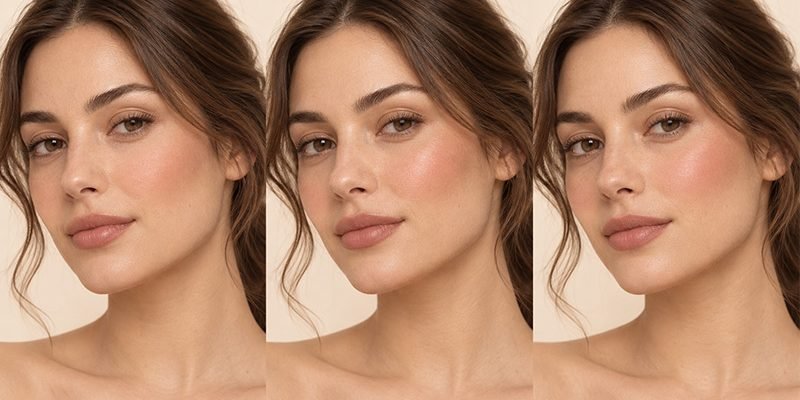
| Evaluation Dimension | Powder Blush | Cream Blush | Liquid Blush |
|---|---|---|---|
| Primary Base Carrier | Talc, Mica, Binders | Waxes, Vegetable/Ester Oils | Water, Volatile Silicones, Polymers |
| Ideal Skin Types | Oily, Combination-Oily, Acne-Prone | Dry, Very Dry, Normal, Mature | Combination, Normal, All (Long-wear) |
| Finish | Matte, Satin, Shimmer (Soft-focus) | Dewy, Luminous, Glass-Skin | Natural, Velvet, Stained Flush |
| Pigment Concentration | Moderate (Buildable) | Sheer to Medium | High to Ultra-High |
| Longevity | 8 – 12 Hours | 4 – 6 Hours | 10 – 14 Hours |
| Texture Camouflage | Excellent (Blurs pores) | Fair (Highlights large pores) | High (Melts into skin texture) |
| Blending Working Time | Long (Unlimited until set) | Moderate (Easy to rework) | Short (15–30s fast dry-down) |
| Sweat & Humidity Resistance | Moderate (Can cake with sebum) | Low (Prone to sliding) | Very High (Film-forming barrier) |
| Application Layer in Routine | After setting powder | Before powder | Before powder |
5. Skin-Type Decision Framework: Which Formula Should You Pick?
1. Dry to Extremely Dry Skin
- Winning Formula: Cream Blush (Primary) or Hydrating Liquid Blush.
- Why It Works: Dry skin lacks natural lipid secretions. Cream blushes contain emollients like squalane and jojoba oil that act as secondary occlusives, preventing transepidermal water loss (TEWL) and giving cheeks a plump, light-reflecting glow.
- Application Tip: Apply over a hydrating tinted moisturizer using your fingertips to gently press product into cheeks.
2. Oily & Acne-Prone Skin
- Winning Formula: Powder Blush (Primary) or Non-Comedogenic Matte Liquid Blush.
- Why It Works: Sebum overproduction breaks down oil-based waxes quickly. Powder blushes packed with silica and zinc stearate absorb mid-day oil breakthrough, preventing blush from sliding into pores or breaking out congested skin.
- Application Tip: Lightly dust translucent powder over cheeks first to create a uniform canvas, then apply powder blush with a soft domed brush.
3. Combination Skin (Oily T-Zone, Dry U-Zone)
- Winning Formula: Liquid Blush or the “Layering Cocktail” (Liquid + Powder).
- Why It Works: Liquid blush adheres evenly regardless of uneven sebum distribution across the cheek area. For all-day weddings or events, set a liquid blush with a matching dusting of sheer powder blush.
- Application Tip: Place liquid blush higher on the cheekbones (outside the porous T-zone), then lock the center of the face with translucent powder.
4. Mature Skin (Fine Lines, Loss of Elasticity)
- Winning Formula: Cream or Fluid Liquid Blush with Light-Diffusing Micro-Pearl.
- Why It Works: Heavy talc powders settle into dynamic smile lines and nasolabial folds, creating an aged, cakey look. Cream formulas melt over skin folds, while lipid-based gloss bounces light away from fine lines.
- Application Tip: Avoid heavy shimmers or large glitters. Blend cream blush upward toward the temples to create an optical lifting effect.
5. Sensitive & Reactive Skin
- Winning Formula: Mineral Baked Powder or Clean-Formulated Minimalist Liquid Blush.
- Why It Works: Look for formulas free from synthetic fragrance, essential oils, and heavy bismuth oxychloride (which can cause itching). Baked mineral powders contain inert, skin-calming iron oxides.

6. Common Application Mistakes & How to Fix Them
Mistake 1: Applying Cream/Liquid Blush Over Set Powder
- Why it fails: The oils in cream/liquid blush dissolve the talc/starch powder matrix beneath, causing instant curdling and bare patches.
- The Fix: Liquid/Cream BEFORE powder, Powder AFTER powder. If you forgot, mist face with setting spray first to re-hydrate the powder layer before tapping cream with a sponge.
Mistake 2: Dotting Liquid Blush Directly on the Cheek
- Why it fails: High-pigment formulas set in 15 seconds. Direct applicator contact often leaves un-blendable “hot spots”.
- The Fix: Dot onto the back of your hand, warm and spread with a synthetic brush, then stamp onto the face.
Mistake 3: Relying on Cream Blush for Humid / All-Day Events
- Why it fails: Without volatile film formers or oil-absorbent powders, waxes soften under high ambient heat and migrate.
- The Fix: Use the “Monochromatic Sandwiching” technique: Liquid/cream blush →→ sheer translucent setting powder →→ whisper of matching powder blush.

7. Formulator & Manufacturing Insights (The Pro's Perspective
From an R&D and cosmetics OEM/ODM manufacturing perspective, formula selection involves distinct cost structures and technical trade-offs:
(1)Pigment Micronization & Grinding Costs: Liquid and cream blushes require 3-roll milling or bead milling to grind pigments below 5 μm5 μm. Poorly milled liquid blush results in gritty texture, pigment precipitation, and streaky application.
(2)Preservative & Oxidation Challenge: Anhydrous cream blushes do not support bacterial growth (low water activity aw<0.6aw<0.6), but they are vulnerable to lipid rancidity. Formulators must dose Tocopherol (Vitamin E) or BHT. Liquid water-based blushes require broad-spectrum antimicrobial systems (Phenoxyethanol, Ethylhexylglycerin) to pass challenge testing.
(3)Filling & Molding Technology:
- Powder: Requires precise compaction pressure (10–15 kg/cm210–15 kg/cm2) and binder ratios. Too high creates “hard-pan” (inability to pick up pigment); too low causes product cracking during drop tests.
- Cream: Hot-pour filling at 75∘C–85∘C75∘C–85∘C followed by controlled chill tunnels to prevent wax crystallization and surface sweating.
- Liquid: High-viscosity airless pumps or sponge-tip doe-foot vials with volatile solvent gasket seals to prevent formula evaporation in the bottle.
8. FAQ
Q1: Can I mix cream and powder blush together?
Yes. The “sandwich” technique involves applying cream or liquid blush first to build dimension and skin-like pigment, setting the face with translucent powder, and then lightly sweeping a complementary powder blush on top. This doubles wear time from 5 to 12+ hours.
Q2: Which blush formula looks most natural in natural daylight?
Cream blush looks the most natural in direct daylight because its lipid base mimics the natural moisture barrier and sebum reflection of healthy human skin, preventing the flat or chalky look powder can sometimes give.
Q3: Does powder blush cause acne or clog pores?
Generally, no. Most modern powder blushes use non-comedogenic synthetic fluorphlogopite or purified cosmetic-grade talc. However, failure to clean blush brushes weekly harbors bacteria, which is the leading cause of cheek breakouts from powder blush.
Q4: Why does my liquid blush dry down into patchy spots?
Liquid blush contains volatile solvents (like isododecane) that evaporate rapidly (15–30 seconds). If you leave dots on both cheeks before blending, the first side will dry down and stain before you can disperse the pigment. Blend one cheek completely before applying to the other.
Q5: Is liquid blush better than powder for hot summer days?
Yes, high-performance liquid blush with film-forming silicone polymers is superior for summer. Powder blush can absorb sweat initially but eventually turns cakey or dissolves when mixed with excessive sweat and sebum, whereas film-forming liquid blush forms a water-resistant layer that does not shift.
9. CTA
Upgrade Your Cheek Routine Today:
Still unsure which blush formula will unlock your perfect look? Start by testing a multi-formula mini kit or trying the layering technique with what you already own. If you’re formulating your own beauty line, explore our OEM/ODM blush customization capabilities for clean, high-performance powder, cream, and liquid color cosmetics.