


How can indie beauty brands source private label blush with low MOQs and scale profitably? Scaling an indie beauty brand requires partnering with agile OEM/ODM cosmetics manufacturers that offer tiered Minimum Order Quantities (starting from 500–1,000 units per shade) combined with standardized base formulas and modular custom packaging. Key success factors include:
(1)Formula Selection: Utilizing pre-stabilized base formulas (powder, cream, liquid) to eliminate upfront R&D formulation fees and compress testing cycles from several months down to weeks.
(2)Quality & Compliance Verification: Validating ISO 22716 / GMPC certification, FDA/EU Regulation (EC) No 1223/2009 compliance, microbiological challenge tests, and heavy metal testing (Pb < 10ppm, As < 2ppm).
(3)Packaging Strategy: Adopting in-stock open-mold primary packaging with surface customisation (silk-screen, hot stamping, UV coating) to bypass high custom tooling and injection mold investments.
(4)Supply Chain Agility: Establishing flexible lead-time contracts (fast turnaround for reorders) to prevent inventory over-leverage while maintaining healthy gross retail margins.
1. The Indie Beauty Sourcing Dilemma: The Trap of Traditional High MOQs
The global color cosmetics market is undergoing a seismic shift. Direct-to-Consumer (DTC) channels, viral social media trends, and niche aesthetic communities require indie beauty founders to test product concepts rapidly. However, traditional contract manufacturing creates severe friction for growing brands:
- Heavy Capital Lock-In: Legacy manufacturers typically mandate 10,000 to 20,000 units per shade. For a launch featuring multiple complementary shades, a founder must commit substantial working capital upfront just to clear production minimums.
- Severe Inventory & Expiration Risk: Color trends evolve rapidly. Excess unsold stock ties up operational cash flow and risks expiration or binder breakdown past the standard shelf-life window.
- Prolonged Time-to-Market: Legacy production queues often span multiple quarters, causing brands to miss viral consumer demand windows entirely.
+-----------------------------------------------------------------------------------+
|                        Traditional vs. Agile Sourcing Model                       |
+-----------------------------------------------------------------------------------+
|  Traditional OEM/ODM:   [ 10,000+ Units/SKU ] ---> [ High Inventory Risk & Slow ] |
|                                                                                   |
|  Agile Flexible Supply: [ 500 - 1,000 Units ] ---> [ Fast Testing & Rapid Scale ] |
+-----------------------------------------------------------------------------------+
Agile private labeling solves this structural inefficiency through flexible manufacturing lines, rapid batch-color matching, and modular component inventories, enabling emerging brands to launch professional-grade cosmetics with institutional precision.
2. What Defines a True Low MOQ Blush Manufacturer?
Not all suppliers marketing “Low MOQ” operate genuinely flexible supply chains. Many intermediaries act as trading brokers, adding significant markups while outsourcing production to third-party factories.
A genuine low MOQ direct manufacturer possesses specific technical infrastructure:
(1)Small-Batch Precision Blending Equipment: Automated micro-jet pulverizers (jet mills) and small-capacity dry powder mixers (5 kg to 25 kg batches) that maintain shade dispersion consistency without requiring industrial bulk minimums.
(2)Semi-Automated Flexible Assembly Lines: Modular hydraulic pressing machines with quick-change tooling fixtures capable of switching pan dies rapidly.
(3)In-House Stocked Component Warehousing: A library of pre-tested, standardized compact cases, droppers, and tubes ready for immediate surface decoration.
(4)Pre-Cleared Regulatory Raw Material Libraries: Pigments, binding oils, and mica minerals pre-screened under US FDA 21 CFR 73/74 and EU Cosmetic Regulation (EC) No 1223/2009 Annex IV.
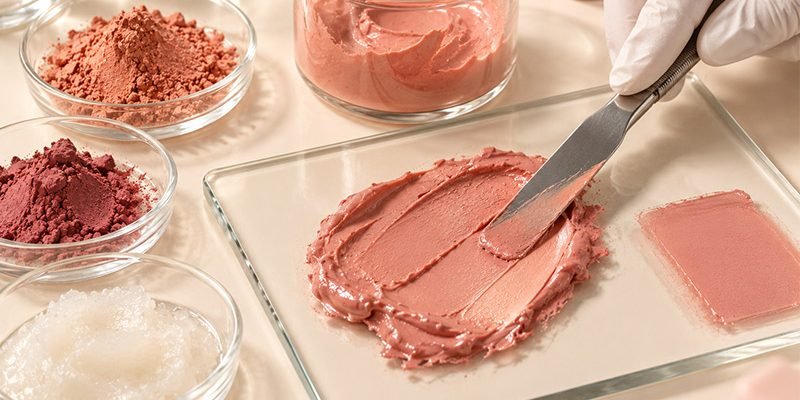
3. Blush Formulations Breakdown: Powder vs. Cream vs. Liquid vs. Hybrid
Selecting the right blush vehicle defines your bill of materials (BOM), production complexity, and retail positioning. Below is a comparative formulation matrix across the four primary blush categories:
| Formulation Type | Key Ingredients & Base Vehicle | Manufacturing Complexity | Minimum MOQ Benchmark | Target Skin Type & Finish | Key Quality Verification Test |
|---|---|---|---|---|---|
| Pressed Powder | Micronized Talc/Mica, Silica, Zinc Stearate, Dimethicone, Pigments (Fe₂O₃, Red Lake) | Moderate (Requires precise binder ratio 3–6% & press pressure) | 500 – 1,000 pcs | Oily to Normal; Matte, Satin, Shimmer | Drop Test (3x from 30cm onto hard wood); Glaze resistance |
| Baked Powder (Terrecotta) | Slurry of wet pigments & minerals baked on terracotta tiles | High (24h drying ovens, hand-doming) | 2,000 – 3,000 pcs | All skin types; Luminous, Marbled, Ultra-blendable | Breakage resistance during transit; Thermal shock stability |
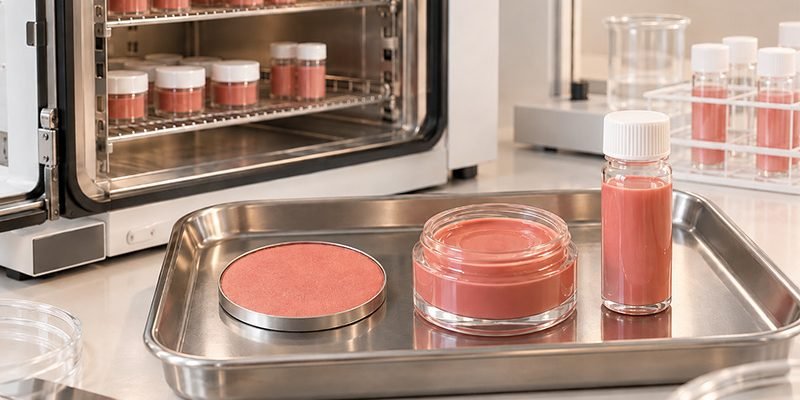
| Cream / Stick Blush | Caprylic/Capric Triglycerides, Candelilla Wax, Shea Butter, Silica, Esters | Moderate (Hot pour filling at 75–80°C, cooling tunnels) | 1,000 pcs | Dry to Normal; Dewy, Balm, Skin-melt | Sweat test (45°C oven for 48h); Centrifuge test (3,000 RPM) |
| Liquid / Serum Blush | Isododecane, Dimethicone Crosspolymer, Emulsifiers, Hydrophobic Pigments | High (Micro-homogenization & suspension rheology) | 1,000 – 2,000 pcs | All skin types; Weightless, Long-wear, Seamless Tint | Viscosity stability at 4°C/45°C; Phase separation testing |
                       ┌─────────────────────────────┐
                       │   Blush Texture Selection     │
                       └──────────────┬──────────────┘
                                      │
              ┌───────────────────────┼────────────────────┐
              ▼                       ▼                       ▼
     [ Pressed Powder ]       [ Cream / Stick ]       [ Liquid / Serum ]
     • Fastest to Market      • High Trend Demand     • Ultra-Lightweight
     • Optimized Base Cost    • Dewy Skin Finish      • Precision Dropper/Wand
     • 500 pcs MOQ            • 1,000 pcs MOQ         • 1,000 pcs MOQ
4. The 4-Pillar Low MOQ Sourcing Model: Formulation, Packaging, Quality & Lead Time
To maintain healthy commercial viability and high retail margins, brand builders must master the four technical pillars of cosmetic procurement:
Pillar 1: Base Formula Customisation vs. Bespoke Chemistry
- Pre-Stabilized Base (Recommended for Launch): The manufacturer provides an optimized base with proven preservation efficacy, skin-feel, and stability data. You customize the Pantone shade, pigment load (8%–18%), fragrance profile, and active skincare infusions (e.g., Squalane, Hyaluronic Acid, Vitamin E) with zero upfront R&D formulation charges.
- Fully Custom Chemical Formulation: Requires custom surfactant-oil ratios, novel rheology, and unique ingredient blends. Requires 12-week real-time stability and PET (Preservative Efficacy Testing) with higher development minimums.
Pillar 2: Packaging Customisation Without Tooling Capex
Do not invest heavy capital into custom steel injection molds for your first collection. Instead, decouple primary packaging:
- Standard Open-Mold Components: Choose luxury acrylic, PCR (Post-Consumer Recycled) plastic, or magnetic paperboard compacts already in factory inventory.
- Surface Finishes: Apply custom Pantone spray coating, soft-touch matte rubberized finishes, metallic hot-stamping, and precision multi-color silk screening without structural tooling expenses.
Pillar 3: Quality Control & Micro-Testing Standards
Every production batch must pass stringent laboratory verification prior to bill-of-lading issuance:
- Microbial Assay: Total Aerobic Microbial Count (TAMC) < 100 CFU/g; Yeast/Mold < 10 CFU/g; Zero E. coli, S. aureus, P. aeruginosa.
- Heavy Metal Screening (ICP-MS): Lead (Pb) < 10 ppm, Arsenic (As) < 2 ppm, Mercury (Hg) < 1 ppm, Cadmium (Cd) < 5 ppm.
- Mechanical Integrity: 3-axis drop test from 30 cm, pan detachment torque test, and lid hinge cycle test (minimum 300 openings).
Pillar 4: Agile Lead Time Windows
- Lab Samples & Shade Swatches: 5–7 business days.
- Pre-Production Samples (PPS with decorated packaging): 10–12 business days.
- Mass Production (Batch 1): 25–30 business days.
- Repeat Reorders: 15–20 business days.
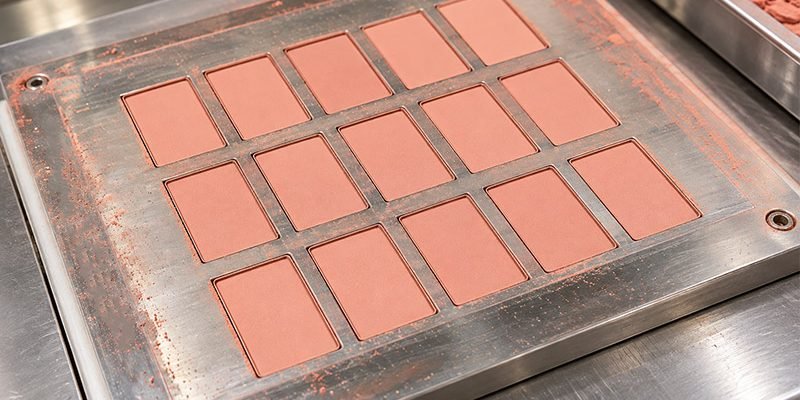
5. Step-by-Step Blueprint: From Shade Concept to Finished Goods in 45 Days
Day 1-7               Day 8-15              Day 16-25             Day 26-40             Day 41-45
[ Product Brief ] ──> [ Lab Sampling ]  ──> [ PPS Approval ]  ──> [ Mass Production] ──> [ QC & Shipping ]
  • Target Pantones     • 2-3 Shade Itrs.     • Packaging Print     • Bulk Mixing         • Final Inspection
  • Texture Selection   • Skin-Feel Review    • Batch Specs Sign    • Pressing/Pouring    • COA & Export
Stage 1: Product Brief & Shade Alignment (Days 1–7)
Submit a precise technical brief detailing target shade references (Pantone Color Codes or benchmark competitor physical samples), desired finish (velvet matte, micro-shimmer, luminous dewy), packaging style, and target compliance markets (US, EU, UK, ASEAN, GCC).
Stage 2: Lab Prototype Formulation & Swatch Iteration (Days 8–15)
The factory compounding chemist produces physical lab samples to evaluate undertone warmth/coolness under standard D65 daylight illuminants, testing blendability, fallout, and skin adhesion across diverse Fitzpatrick skin types (I to VI).
Stage 3: Pre-Production Sample (PPS) & Artwork Sign-Off (Days 16–25)
Finalize dieline artwork vectors (.AI or .PDF format with CMYK + Pantone callouts), receive production-ready PPS units in complete decorated packaging, and sign off on the Golden Standard Master Sample.
Stage 4: Mass Compounding, Filling & Assembly (Days 26–40)
Bulk pigment wetting, jet milling, binder atomization, and hydraulic pressing or hot filling, followed by inner mirror assembly, secondary box folding, and LOT/EXP batch coding.
Stage 5: Pre-Shipment Inspection & Dispatch (Days 41–45)
Randomized AQL 1.5/2.5 quality inspection, issuance of Certificate of Analysis (COA) and MSDS, and international logistics dispatch (Air DDP or Ocean DDP).
6. Regulatory Compliance, Safety Testing & Global Export Checklist
Exporting cosmetics to top consumer markets requires non-negotiable documentation. Partnering with an audit-ready factory ensures seamless customs clearance and retail compliance:
- United States (FDA / MoCRA Compliance):
- Facility Registration & Cosmetic Product Listing (Section 607)
- Safety Substantiation File (Section 608)
- Color Additive Batch Certification for synthetic organic colorants (FD&C / D&C Lakes)
- Standardized INCI Ingredient Labeling (21 CFR 701.3)
- European Union & UK (EC No 1223/2009 & UK Regulation):
- Cosmetic Product Safety Report (CPSR Part A & Part B signed by a certified Toxicologist)
- Product Information File (PIF) & CPNP/SCPN Portal Notification
- EU/UK Designated Responsible Person (RP) representation
- Universal Facility Standards:
- ISO 22716:2007 (Cosmetics GMP) & US FDA GMPC Certified Production Facility
- Cruelty-Free / Vegan Audit Dossier (PETA / Leaping Bunny compliance support)
7. Top 5 Mistakes Indie Brands Make When Sourcing Color Cosmetics
(1)Underestimating Secondary Packaging Weight & Dimensions: Bulky heavy-walled compacts escalate international air-freight costs significantly. Always calculate dimensional weight (CBM) before approving packaging specs.
(2)Ignoring Drop Test Standards for Pressed Powders: Failing to specify drop-test requirements leads to shattered powder cakes during courier transit, resulting in negative customer reviews.
(3)Failing to Retain Counter-Samples: Always maintain identical physical samples from each production batch to settle color variance disputes.
(4)Ordering Custom Formulation for Initial Launch: Demanding bespoke chemistry adds unnecessary testing lead times and delays product launches without delivering measurable consumer differentiation over refined stock bases.
(5)Overlooking Regulatory Color Restrictions: Certain FDA-approved colorants face strict restriction concentrations in eye areas or specific international regions. Verify clean INCI listings prior to printing boxes.
8. FAQ
Q1: What is the absolute minimum order quantity (MOQ) for custom private label blush?
Our flexible OEM/ODM manufacturing lines accommodate orders starting at 500 units per shade for existing base formulations in stock open-mold packaging with fully customized surface printing and brand artwork.
Q2: How does the sampling and development process work?
Brands can request standard pre-formulated texture kits or bespoke color-matched prototypes based on Pantone references. Sampling deposits are routinely credited back toward your first mass production purchase order.
Q3: What is the typical production lead time for first-time orders vs. repeat orders?
First-time private label production takes 25 to 30 business days from final artwork and deposit confirmation. Repeat reorders are completed in 15 to 20 business days since tooling plates and formulation parameters are archived.
Q4: Can we infuse skincare actives (e.g., Niacinamide, Squalane, Peptides) into the blush base?
Yes. Our R&D chemists routinely incorporate oil-soluble and micro-encapsulated skincare actives into powder, cream, and liquid blush matrices at validated efficacy levels (0.5%–3.0%) without destabilizing formula preservation or wear performance.
Q5: How do you guarantee shade consistency between separate production batches?
We utilize automated spectrophotometers (Delta E < 0.8 tolerance) to measure color coordinates (L∗a∗b∗L∗a∗b∗) alongside manual side-by-side draw-down comparisons against the sealed Golden Master Sample under calibrated D65 light booths.
9. Partner with an Agile OEM/ODM Manufacturer (CTA & Sample Kit Request)
Are you an indie beauty founder or product developer ready to launch your next hero blush collection without tying up critical growth capital?
+------------------------------------------------------------------------------------+
|                         ACCELERATE YOUR COSMETICS LAUNCH                           |
|                                                                                    |
|  ✓ 500 pcs/shade Low MOQ Starting Tier                                             |
|  ✓ 1,200+ Pre-Tested High-Pigment Clean Formulations                               |
|  ✓ ISO 22716 & FDA GMPC Certified Production Facility                             |
|  ✓ Full Compliance Dossier (COA, MSDS, MoCRA, CPSR)                                |
|  ✓ 7-Day Fast Sampling & 25-Day Guaranteed Mass Production                         |
+------------------------------------------------------------------------------------+
[Request Your Custom Blush Sample Kit & OEM Quote Today]
Get in touch with our cosmetic formulation team to receive physical shade swatches, packaging catalogues, and a custom landed cost calculation tailored to your brand.