


The global blush market is experiencing unprecedented momentum, projected to exceed $2.8 billion by 2030, driven by viral social media makeup trends (“Clean Girl”, “Sunset Blush”, “Boyfriend Blush”) and hybrid skincare-makeup innovations. For indie beauty founders and product developers in North America and Europe, launching a custom blush line offers high operating margins , strong customer retention, and viral organic reach.
However, transitioning from a creative vision to a compliant, high-performing commercial batch requires navigating complex pigment dispersion science, texture-specific rheology, packaging compatibility, and strict regulatory frameworks like the US MoCRA (Modernization of Cosmetics Regulation Act) and EU Regulation (EC) No 1223/2009. Selecting the optimal formula vehicle—Pressed/Baked Powder, Anhydrous Cream, or Low-Viscosity Liquid/Serum—is the foundational strategic decision that defines your supply chain, stability testing timeline, and consumer experience.
1. The Anatomy of Blush: Base Chemistry & Pigment Engineering
Regardless of texture, every high-performance blush is an engineered equilibrium of four functional systems:
- Structural Base / Bulk Phase:
- Provides bulk volume, slip, pay-off, and structural integrity. (e.g., Talc-free Mica/Synthetic Fluorphlogopite and Boron Nitride for powders; Hydrogenated Polyisobutene, Synthetic Wax, and Isoamyl Laurate for creams; Isododecane, Cyclopentasiloxane, or Caprylic/Capric Triglyceride for liquids).
- Pigment Dispersion & Colorant System:
- Inorganic Pigments: Iron Oxides (CI 77491, CI 77492, CI 77499) for undertone depth, and Titanium Dioxide (CI 77891) for opacity and pastel tone modulation.
- Organic Lakes: Red 7 Lake (CI 15850), Red 6 Lake (CI 15850), Yellow 5 Lake (CI 19140) for high-chroma vibrancy.
- Surface Treatment: Wetting pigments with Triethoxycaprylylsilane (silane-treated) or Lauroyl Lysine (amino-acid treated) is non-negotiable to prevent streaking, agglomeration, and phase separation.
- Texture & Sensory Modifiers:
- Silica micro-spheres (oil absorption and soft-focus blurring), Nylon-12 or PMMA (velvety slip), and spherical elastomer gels for bounce and non-tacky skin finish.
- Preservation, Antioxidant & Chelating Complex:
- Tocopherol/BHT (lipid oxidation control), Phenoxyethanol + Ethylhexylglycerin or Caprylyl Glycol (broad-spectrum antimicrobial), and Disodium EDTA (metal ion sequestration).
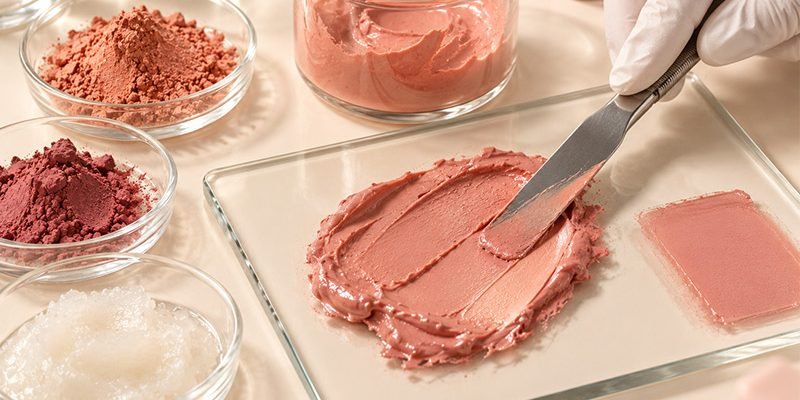
2. Deep-Dive Formulation: Powder Blush (Pressed & Baked)
Powder blushes remain the industry anchor, accounting for over 52% of total retail salesdue to their blendability, long shelf-life, and cost-efficient tooling.
- Key Base Choices: The US/EU market demands Talc-Free alternatives. The modern gold standard combines Synthetic Fluorphlogopite (clean base, zero gray undertone), Sericite Mica (featherweight slip), and Boron Nitride (creamy adherence).
- Liquid Binder System (3%–7%): Critical for mechanical cohesion and skin adhesion. Uses a balance of low-viscosity esters (e.g., Octyldodecyl Stearoyl Stearate, Diisostearyl Malate) and lightweight silicones (Dimethicone).
- Manufacturing & Pressing Parameters:
- Micronization: Multi-stage jet milling (air jet pulverization) to achieve mean particle size D50≤10–15 μmD50≤10–15μm.
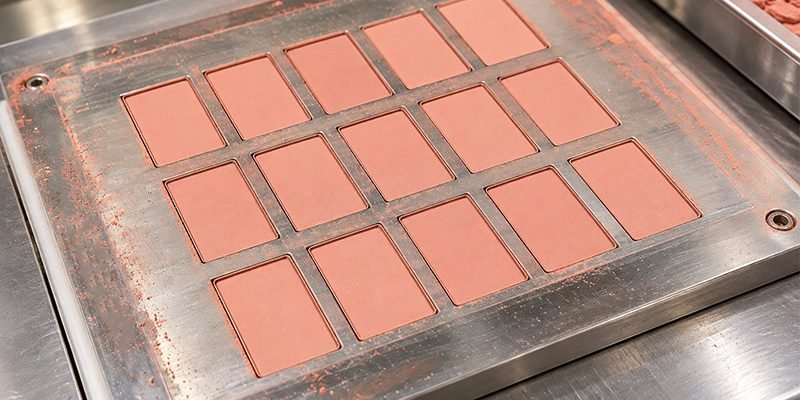
- Compaction Pressure: Hydraulic press calibrated at 30–55 bar (435–800 PSI) using specialized back-suction and degassing cycles to avoid pan capping, cracking, or surface glazing.
- Drop Test Standards: 3 consecutive drops from 30–36 inches (0.8–0.9 m) onto a hardwood/concrete surface with zero fragmentation.
3. Deep-Dive Formulation: Cream & Stick Blush
Cream and stick formulations cater to the “dewy, second-skin” aesthetic. They are formulated either as anhydrous (waterless) wax-oil structures or inverse water-in-oil (W/O) emulsions.
- Wax-Ester Matrix Engineering (Drop Point Control):
- Blend high-melting microcrystalline or synthetic waxes (80∘C–88∘C80∘C–88∘C) with soft carnauba/candelilla waxes (72∘C–78∘C72∘C–78∘C) and low-melting ozokerite (65∘C–70∘C65∘C–70∘C).
- Target drop point / melting threshold: 68∘C–75∘C68∘C–75∘C to prevent “sweating” (syneresis) during summer transit while ensuring instant melting at body temperature (37∘C37∘C) upon application.
- Emollient & Dry-Slip Balance:
- Combine cushiony esters (Isononyl Isononanoate, Pentaerythrityl Tetraisostearate) with volatile carriers (Isohexadecane, C13-15 Alkane) and spherical silica for a “cream-to-powder” dry down.
- Dispersion Equipment: Triple-roll milling (3-roll mill) or high-shear bead milling at 75∘C–80∘C75∘C–80∘C to homogenize pigments without color streaks.
4. Deep-Dive Formulation: Liquid & Serum Blush
Liquid blushes represent the fastest-growing sub-category in North America, favored for their weightless feel, buildable pigmentation, and compatibility with skincare active infusions (Hyaluronic Acid, Niacinamide, Squalane).
- Emulsion System: Primarily Water-in-Silicone (W/Si) or Water-in-Oil (W/O) emulsions utilizing polymeric emulsifiers like PEG-10 Dimethicone, Lauryl PEG-9 Polydimethylsiloxyethyl Dimethicone, or Polyglyceryl-4 Diisostearate/Polyhydroxystearate/Sebacate.
- Rheology & Anti-Settling Control:
- Viscosity target: 3,500–8,500 mPa⋅s3,500–8,500mPa⋅s (cPs) at 25∘C25∘C.
- Utilizes Disteardimonium Hectorite activated with Propylene Carbonate, combined with Acrylates Copolymer or Xanthan Gum in the internal water phase, preventing dense mineral pigments from precipitating over a 24-month shelf life.
- Packaging & Dispensing Engineering: Compatibility verification with flocked doe-foot applicators, airless pump pens, or dropper assemblies to prevent wiper leakage, clogging, or solvent evaporation.
5. Comparative Formulation & Commercial Decision Matrix
| Evaluation Parameter | Powder Blush (Pressed/Baked) | Cream / Stick Blush | Liquid / Serum Blush |
|---|---|---|---|
| Finish & Pay-off | Soft-matte to luminous pearl, high precision blending | Dewy, second-skin, natural flush, melts into base | Ultra-lightweight, seamless watercolor diffusion |
| Typical Pigment Load | 10% – 25% | 8% – 18% | 4% – 12% |
| Formulation Complexity | Low – Medium (Binder balance & pressing stability) | Medium (Wax-oil synergy & thermal drop point) | High (W/Si emulsification, rheology & anti-settling) |
| Tooling & Packaging Flexibility | High Flexibility: Wide range of standard pans & custom embossing dies | Moderate: Requires multi-cavity silicone/metal molds for custom shapes | Component-Driven: Leverages standard droppers/airless pumps to bespoke bottles |
| Batch Scalability & MOQ Tier | Highly Agile: Excellent for small-batch validation & rapid scaling | Flexible: Tiered scaling based on formula & component selection | Scalable: Project-dependent scaling optimized for batch size & filling lines |
| Relative Cost Dynamic | Economy to Mid-tier: Highly cost-efficient bulk & tooling amortization | Mid-tier: Balanced by specialty wax/ester grades & hot-pour filling | Mid to Premium: Driven by active infusions & specialized applicator packaging |
| Speed to Market | Fast: Rapid turnaround with off-the-shelf pans & mature bases | Fast–Moderate: Quick prototype with standard stick/pot components | Moderate: Requires standard emulsion stability & wiper testing |
| Target Skin Type | Normal to Oily / Combination | Normal to Dry / Mature Skin | All Skin Types / Dehydrated Skin |
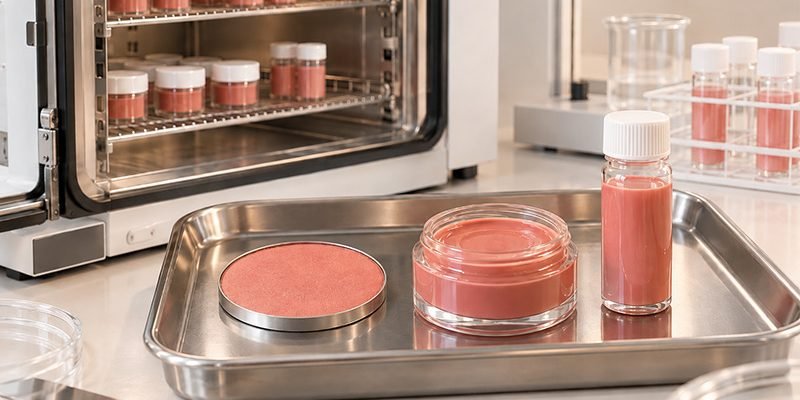
6. Quality Assurance & Laboratory Stability Testing
To prevent catastrophic retail recalls and ensure consumer safety, your lab batch must successfully pass five standardized testing protocols:
- Thermal Stability Cycle:
- Stored at 45∘C±2∘C45∘C±2∘C (accelerated aging), 4∘C4∘C (refrigeration), and 25∘C25∘C (ambient control) for 12 weeks (equivalent to 24–36 months real-time stability).
- Freeze-Thaw Cycling: 3 to 5 alternating cycles (−10∘C−10∘C for 24h →45∘C→45∘C for 24h) to confirm emulsion stability and zero crystal bloom in creams.
- Microbiological Challenge Test (PET – USP 51 / ISO 11930):
- Inoculation with Pseudomonas aeruginosa, Staphylococcus aureus, Escherichia coli, Candida albicans, and Aspergillus brasiliensis. Minimum ≥3 log10≥3log10 reduction at Day 14 and no increase at Day 28.
- Heavy Metal ICP-MS Analysis:
- Lead (Pb) <2 ppm<2ppm, Arsenic (As) <1 ppm<1ppm, Mercury (Hg) <0.5 ppm<0.5ppm, Cadmium (Cd) <1 ppm<1ppm, Antimony (Sb) <0.5 ppm<0.5ppm.
- Centrifuge Stress Test (Liquids & Creams):
- 3,500 – 4,000 RPM at 25∘C25∘C for 30 minutes; zero delamination, syneresis, or oil banding allowed.
- Drop & Mechanical Vibration Transit Testing:
- Conforms to ISTA 3A shipping vibration simulations to prevent pressed powder shatter or cap breakage.
7. End-to-End Launch Roadmap: Timeline & Milestones
A standard development timeline spans 16 to 24 weeks from concept brief to commercial launch:
[Weeks 1-3] Concept Brief & Benchmark Benchmarking
    │  └── Define target texture, color pantone targets, finish, clean beauty blacklist
    ▼
[Weeks 4-7] Lab Formulation Rounds & Shade Matching (Rounds 1-3)
    │  └── Lab samples delivery, sensory panel testing, consumer blind testing
    ▼
[Weeks 8-11] Packaging Compatibility & Stability Sign-off
    │  └── Thermal chambers, PET challenge, micro-testing, drop-tests
    ▼
[Weeks 12-15] Regulatory Dossier, MoCRA/CPSR & Artwork Pre-press
    │  └── PIF generation, INCI label reviews, batch coding compliance
    ▼
[Weeks 16-20] Mass Production, Cleanroom Filling & Quality Auditing
    │  └── Bulk compounding, high-speed automated pressing/filling, inline AQL 1.0/2.5 checks
    ▼
[Weeks 21-24] International Freight, Customs Clearance & Commercial Go-To-Market
8. FAQ
Q1: What is the most cost-effective blush texture for an indie brand’s first launch?
Pressed powder blush offers the lowest technical barrier and lowest initial packaging risk. It features standardized pan sizes (e.g., 36mm, 42mm, 59mm), low unit mold costs, longer shelf-life, and forgiving storage tolerances compared to liquid and cream emulsions.
Q2: How do we develop custom blush shades that flatter diverse global skin undertones?
A: Formulate around three distinct undertone pillars: Cool (incorporate blue-toned Red 7 Lake and violet undertones), Warm (balance Yellow 5 Lake with terracotta Iron Oxides), and Neutral/Deep (elevate high-chroma micronized Red 6 and decrease Titanium Dioxide to prevent ashy flashback on rich melanin-rich skin tones).
Q3: Can we achieve high-performance blushes with a 100% “Clean / Talc-Free” formula?
A: Yes. By replacing talc with high-purity Synthetic Fluorphlogopite (Synthetic Mica) combined with Tapioca/Rice Starch and Lauroyl Lysine-treated pigments, you can achieve even smoother slip, superior color purity, and a buttery skin feel without compromising performance.
9. CTA
Ready to Launch Your Custom Blush Line with Low MOQ & Lab Precision?
Transforming your cosmetic vision into award-winning, retail-ready products requires a manufacturing partner with world-class formulation science and agile production capabilities.
- 🧪 Fast-Track Lab Formulation & 1:1 Color Precision: Proprietary 1:1 Color Restoration technology, custom texture tailoring, and prototype lab samples delivered in as fast as 3–7 business days (leveraging a proven library of 2,000+ mature base formulas).
- 📦 Agile Low MOQ Scaling: Low minimum order quantities starting from 500–1,000 units per shade to protect your cash flow and de-risk market testing.
- ✨ Signature Craftsmanship Options: High-precision 3D Intricate Embossing, Baked Marbleized Fusion, and Crystalline Luster finishes to create viral social-media-ready aesthetics.
- 🛡️ Global Turnkey Compliance: Complete FDA MoCRA registration, EU CPSR toxicological dossier support, clean beauty blacklist formulation, and ISO 22716 / GMPC certified cleanroom manufacturing.
[👉 Request Your Custom Blush Formulation Consultation & Lab Sample Kit with Doriff Today]