

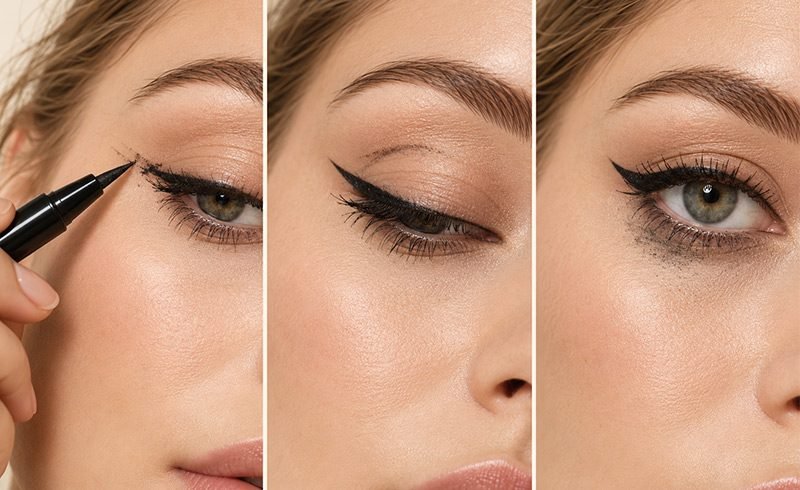
A sharp line in the morning can become a faint stamp on your upper lid or a dark shadow beneath your eyes later in the day. Replacing your eyeliner might help, but the formula is only part of the picture.
To reduce eyeliner smudging, check the surface underneath it, how much you apply, whether it has set, and where your eyelids touch. Waterproof eyeliner can help with moisture exposure, but the label alone does not tell you how it will perform with your skincare, natural oils, or repeated contact.
Start by noticing where the color moves. That gives you a more useful starting point than adding another layer of liner or changing your entire routine.
1. First, Check Where and When Your Eyeliner Smudges
Smudging, transfer, and fading describe different changes. Smudging means the edge spreads or becomes blurred. Transfer happens when color moves onto another surface, such as the skin above your lash line. Fading means the original line loses intensity. More than one can happen during the same day.
The pattern is a clue, rather than a diagnosis. For example, Laura Geller’s eyeliner guide identifies folded lids, natural oils, watery eyes, and excess product underneath as possible contributors. Those factors can overlap.
| What you notice | What to check first | A useful next step |
|---|---|---|
| The line smears during application | A slippery base, wet layers, or accidental contact | Simplify the base and apply a thinner line |
| A matching mark appears on the upper lid | Contact between the lined area and the lid above it | Check placement with your eyes open and allow the liner to set |
| Color appears beneath the eyes after several hours | Product migration, skincare contact, or mascara transfer | Identify which product is moving before replacing it |
| Color wears away near an eye corner | Local moisture, touching, or product placement | Observe the contact point and check the product’s intended use |
Change one relevant part of your routine at a time. If you replace the liner, primer, eye cream, and setting products together, you will have little idea which change helped.
2. 7 Eyeliner Mistakes—and What to Change
(1)Applying Eyeliner Over a Slippery Base
An eyelid that still feels slick from skincare gives you a different starting surface from one that feels settled. Natural oils, a rich eye cream, or a heavy layer of concealer can all contribute to that slippery feel. Makeup.com’s guide to eyeliner bleeding specifically discusses oily skin and eye cream applied too heavily or too close to makeup application.
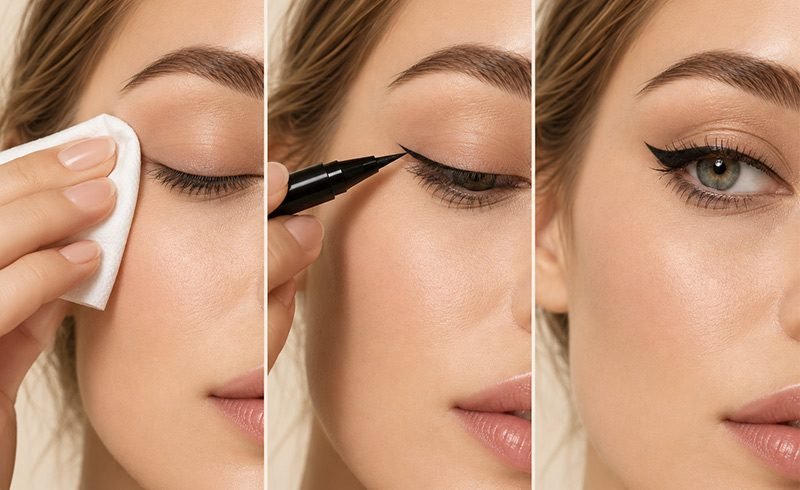
Before drawing your line, check the external skin near the lashes. Let skincare settle, then gently press away excess surface residue with a clean tissue if needed. Avoid scrubbing the area or trying to remove every trace of natural oil.
If your liner repeatedly moves on oily lids, try a thin layer of an eye primer used according to its instructions. Judge the result against your usual routine: primer is useful when it improves that particular combination, rather than being a compulsory extra layer for everyone.
(2)Assuming “Waterproof” Means Resistance to Every Kind of Smudging
Waterproof, smudge-resistant, and transfer-resistant describe different performance claims. A waterproof label does not, by itself, establish how a liner behaves when it meets oily skincare or repeatedly touches another part of the eyelid. Official product descriptions sometimes list these properties separately; Urban Decay’s waterline pencil page, for example, distinguishes waterproof wear from transfer, smudge, and sweat resistance. These remain claims about that specific product.
Choose around the problem you actually experience. If moisture is involved, water resistance is relevant. If the line leaves an imprint above the lashes, placement, setting, and transfer performance deserve attention too.
Do not assume that every liquid liner outlasts every pencil. A pencil intended for a softly blended effect and a liquid intended for a crisp wing serve different purposes; the complete formula and your application conditions matter more than the format alone.
(3)Building a Thick Line With Repeated Wet Layers
Going over the same line repeatedly can deposit more product than you intended. This is especially easy when you keep correcting the shape while earlier strokes are still wet. Laura Geller’s guide identifies repeated layering as a possible contributor to transfer. Treat this as a reason to check your application amount, rather than assuming every formula behaves the same way.
Begin with the thinnest line that gives you the shape you want. Use short, connected strokes, then inspect the result before adding more. If one small section looks faint, fill that section rather than tracing the entire line again.
A bold wing is still possible. The aim is controlled placement, with additional product where the design needs it. If repeated passes keep lifting the color or making the line uneven, follow the product’s layering instructions rather than continuing to work the same wet area.
(4)Touching or Curling Lashes Before the Liner Has Set
A liner that looks finished may still be vulnerable to contact. An eyelash curler, fingertip, or brush can disturb the line before it has settled. L’Oréal Paris’s eyeliner smudging guide identifies curling after lining as a possible source of smears.
Curl your lashes before applying eyeliner. After lining, leave the area undisturbed before moving on to a step that could touch it.
There is no single waiting time that suits every liner and application thickness. Follow the instructions for your product, and avoid repeatedly touching the line to check whether it has dried.
(5)Ignoring Where Your Eyelids Touch
If your eyeliner leaves a curved mark above the lash line, check whether the two areas meet when you open your eyes. On folded or hooded lids, a line that looks well placed with the eye closed may sit directly against another part of the skin when the eye opens. Both L’Oréal Paris and Laura Geller discuss this contact as a factor in transfer.
Look straight into a mirror with your eyes comfortably open. Notice where the lined area disappears into a fold or touches the lid above it. Try keeping the lash-line section finer and adjusting the wing locally, rather than simply making the whole line thicker.
This is a placement adjustment, not a rule that everyone with a particular eye shape needs the same wing. The useful question is whether your chosen line remains visible and avoids unnecessary contact on your own lids.
(6)Treating the Waterline Like the Outer Lash Line
The outer lash line and the waterline—the inner rim of the eyelid—are different application areas. Do not assume that an eyeliner intended for the skin above the lashes is also intended for the inner rim. Check the product’s directions and stated uses.
Some products are specifically developed for waterline application, as Urban Decay explains for its waterline pencil. That does not extend the same suitability to other pencils, gels, or liquid liners.
Keep powder eyeshadow and loose setting powder off the waterline. L’Oréal Paris’s guidance makes this distinction when discussing powder over eyeliner: the technique concerns the outer lid, rather than putting powder into the eye’s inner rim.
If your main goal is a clean everyday line, you can concentrate on the external lash line without adding waterline application to your routine.
(7)Adding More Liner Over an Existing Smudge
Once pigment has moved onto nearby skin, drawing over the original line does not remove the misplaced color. It can leave you with a darker line and the same blurred edge. Laura Geller’s guide similarly advises against trying to correct smudges by adding more eyeliner.
Clean the small affected area first. On external skin, use a clean cotton swab with a little eye makeup remover suitable for the area, taking care to keep it out of the eye. Let the skin dry; if it still feels slippery, remove the remaining surface residue gently before redrawing.
Repair only the section that needs it. A small gap at the outer corner does not require another full coat from the inner corner outward. If you keep repairing the same place, return to the earlier checks for contact, moisture, and the base underneath.
3. For Beauty Brands: Evaluate More Than a Waterproof Claim
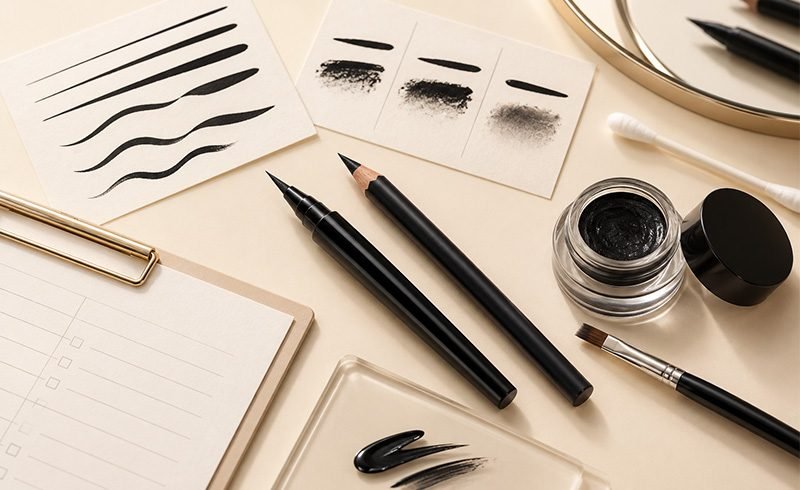
For a beauty brand, an attractive hand swatch is a starting observation. It does not establish how an eyeliner will behave on the eyelid, alongside skincare, or during normal blinking and wear.
Begin with the intended use. A liner designed for a sharp external wing needs a different evaluation brief from a pencil designed to blend into a soft smoky edge. Looking across different eyeliner options is more useful once the target line, finish, and application area are defined.
Keep the following observations separate when comparing samples:
| Evaluation area | What to record |
|---|---|
| Sample identity | Version, shade, component, and date received |
| Application | Line continuity, control, coverage, and the need for repeated passes |
| Setting behavior | Application thickness, instructions followed, and when subsequent steps were performed |
| Transfer and wear | Where color moves or fades, when it happens, and relevant use conditions |
| Product combinations | Skincare, primer, eyeshadow, and mascara used alongside the sample |
| Claim support | Which claims have supporting evidence, the conditions covered, and unresolved questions |
These are suggested comparison records, not a standardized pass/fail test. Keep your comparison conditions reasonably consistent, document changes, and ask the supplier for evidence relevant to the intended claim. A sample trial does not replace appropriate product testing or regulatory review.
Doriff’s custom formulation service provides a starting point for discussing an eyeliner development brief. Any performance statement used for a finished project should be supported for the relevant formula, packaging, and intended use.
4. Frequently Asked Questions
Q1:Should You Set Eyeliner With Eyeshadow?
A small amount of matching powder eyeshadow over an external eyeliner line is one technique described in L’Oréal Paris’s guide. It may be worth trying with a compatible product combination, but it can soften the edge or change the finish. Follow your liner’s directions, use a light hand, and keep powder off the waterline. It is not a required step for every liner.
Q2:Is Liquid Eyeliner Always Less Likely to Smudge Than Pencil?
No. Format alone does not establish how a particular liner will wear. A pencil may offer time to blend before setting, while a liquid may be intended for a defined edge. Compare specific products by their directions, supported claims, and performance in your routine.
Q3:Could the Smudge Be Coming From Mascara Instead?
Yes. Mascara can also smear or transfer, so an under-eye mark does not identify eyeliner as the source. L’Oréal Paris’s mascara guide discusses slippery surrounding products and transfer before mascara has dried.
To narrow down the source, try your usual eyeliner without mascara on one occasion, then mascara without eyeliner on another, keeping the rest of the routine similar. Treat the result as a practical clue rather than proof from a controlled test.
5. Start With the Cause, Then Adjust Your Routine
These seven mistakes are useful checks, not a list of things every eyeliner wearer is doing wrong. Start with the pattern you can see: immediate smearing, an upper-lid imprint, or color appearing beneath the eye later.
Adjust the most relevant factor first, then observe the result. A thinner application, a settled base, or a small placement change may help; persistent problems may call for a different formula. The goal is an eyeliner and routine that work together for your preferred look.
For brands developing an eyeliner range, define the intended application area, line style, finish, and wear expectations before comparing samples. Share that brief with Doriff to discuss custom eyeliner development and the evidence needed for your proposed claims.