


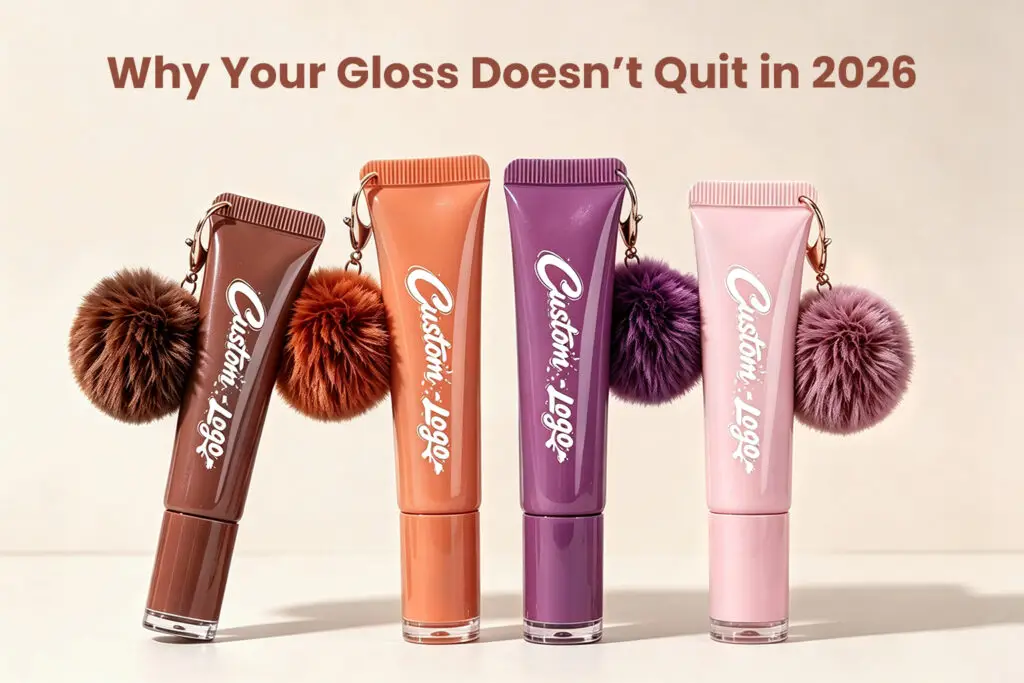
Lip Lock 101: The Secret Ingredient Behind the Gloss That Survives Your Day
Let’s keep it 100: we’ve all been ghosted by a lip gloss. You apply that perfect, mirror-like shine before heading out, but by the time you’ve finished your first iced latte, it’s basically gone. In 2026, the “re-apply every 20 minutes” era is officially over. Gen Z is demanding high-performance formulas that match their fast-paced, “Coffee-to-Club” lifestyle.
So, what is actually happening in the lab to make your gloss stay put without feeling like glue? Let’s de-code the tech behind the 24H Locked-In Glow.
The MVP: Film-Forming Polymers
If you want to know what ingredient makes lip gloss last longer, there’s only one real answer: Film-Forming Polymers. Think of these as a high-tech, invisible “shield” for your lips.
Unlike old-school formulas that just sit on top of your skin and slide off, these modern polymers create a flexible, breathable micro-mesh. They grip your lips and move with them—meaning no cracking when you laugh and no fading when you talk. This is the difference between a gloss that looks thick and a gloss that is durable.
The 2026 Upgrade: Bio-Tech Film Formers
While synthetic polymers used to be the only way to get long wear, 2026 is all about Bio-based Film Formers. Derived from fermented sugar or plant resins, these ingredients provide that “locked-in” feel while remaining 100% clean and sustainable.
Pro Tip: Look for “Hydrogenated Polycyclopentadiene” or its bio-alternatives on the label. That’s the secret sauce for that “I can’t believe this isn’t transfer-proof” durability.
Debunking the “Thickness” Myth
A common mistake we see is the idea that sticky or thick equals long-lasting. Plot twist: it doesn’t.
Waxes & Heavy Oils: Adding too much wax makes a gloss feel “gloop-y” and heavy. It might feel like it’s there, but it lacks the grip to actually stay.
The Sweet Spot: In 2026, the trend is “Zero-Gravity Wear.” We use low-migration oils and tackifiers that give the gloss “grip” without the “ick” factor.
How to Spot a High-Performance Formula
When you’re scrolling for your next holy grail, check the ingredient list for these supporting stars:
Tackifiers: These give the gloss that “velcro” grip on the lips without feeling like actual tape.
Viscosity Modifiers: They control the flow, ensuring the gloss doesn’t migrate into the fine lines around your mouth (no more bleeding edges!).
Plant-Based Peptides: These help the moisture stay locked inside while the polymers keep the shine locked outside.
The Verdict: In 2026, you shouldn’t have to choose between a glossy finish and long-wear performance. By understanding the role of film-forming polymers, you can pick a product that works as hard as you do. Ready for a shine that doesn’t quit? Check the ingredients, trust the science, and keep glowing.
FAQ:
Q1: Why do most “long-wear” glosses fail during eating or drinking?
A: Most traditional formulas suffer from Low Interfacial Substantivity. They simply sit on the surface of the lip as a loose oil-and-wax mixture, which is easily displaced by lipids (food) or water (drinks). Our 2026 formula uses Cross-linked Film-Forming Polymers that create a hydrophobic (water-resistant) 3D lattice. Instead of a loose mixture, it forms a “locked-in” shield that anchors the pigments to the lips, ensuring the gloss survives your iced latte.
Q2: Does “long-wear” have to mean the gloss will feel sticky or heavy?
A: That’s a common myth! Stickiness is usually caused by an over-reliance on high-viscosity resins and heavy waxes to force adhesion. We’ve achieved “Zero-Gravity Wear” through Rheological Engineering. By using Thixotropic Modifiers, our gloss is fluid during application but sets into a flexible, non-tacky film. It provides the “grip” of a long-wear product without the “ick” factor of a sticky glue.
Q3: How do you prevent the gloss from “bleeding” or migrating into fine lines?
A: “Bleeding” occurs when low-molecular-weight oils migrate beyond the vermilion border. Our R&D team utilizes Low-Migration Esters and Viscosity Modifiers that control the product’s flow. These ingredients work with the film-forming polymers to keep the formula exactly where you apply it, ensuring sharp, clean edges without the need for a lip liner.